The problem
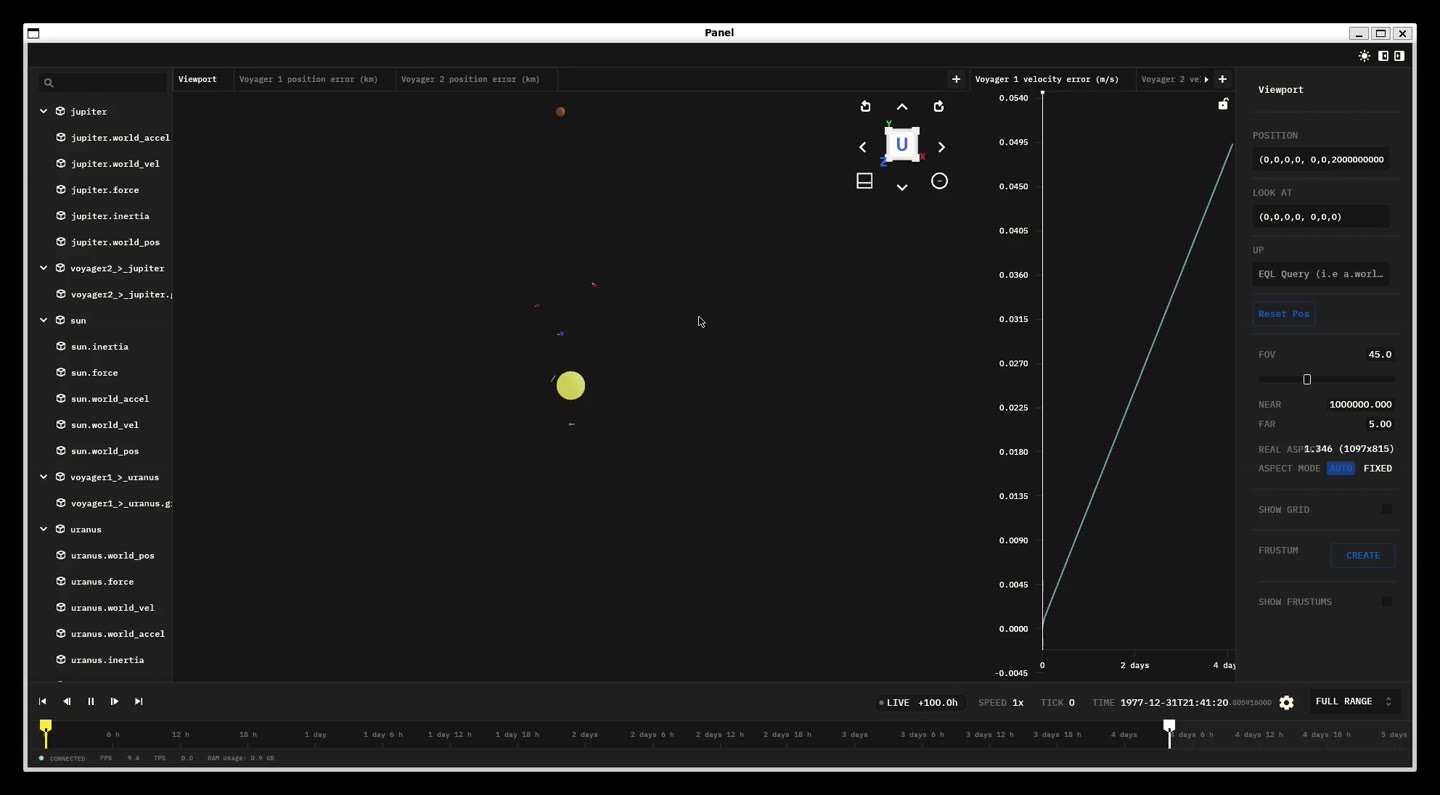
Elodin's Voyager example already displayed simulated and SPICE reference trajectories. Visual separation showed that they diverged, but it did not quantify the error.
A separate modeling issue came from the reference frame: the example integrated Sun-relative states while applying only direct planetary gravity.
Making error visible
I added position error in kilometers and velocity error in meters per second for Voyager 1 and Voyager 2, with four corresponding plots in the editor.
The important detail was timing. The SPICE lookup must match the completed integration tick. I also marked the diagnostic components for external control so the normal world commit would not overwrite the post-step values.
This contribution was merged as PR #769. It added diagnostics without changing the physics model.
Correcting the reference frame
In PR #789, I added an optional heliocentric relative gravity model. In addition to a planet's pull on the spacecraft, it subtracts that planet's acceleration of the Sun, which is the origin of the frame.
I kept the existing chapter as the default. The new chapter reused the kernels, masses, RK4 integrator, and timestep, keeping the change focused and independently reviewable. This contribution was merged.
The next validation case
PR #805 adds a reconstructed Voyager 1 Jupiter case using the February 22-28, 1979 window, with checkpoints on February 24, 26, and 28.
The work compares both chapters against the same SPICE reference and uses Elodin's own integration path. The PR remains open as of September 5, 2026; I am not presenting it as merged work.
What this establishes
These are contributions to a simulation example: measurable divergence and an explicit frame correction. They do not establish navigation-grade accuracy or a validated reconstruction of the gravity assist.
The flyby illustration on the homepage is a separate two-body teaching model. It is not a visualization of the PR's measured results.
About the flyby illustration
The homepage draws a hyperbolic trajectory in a Jupiter-centered frame. Changing the closest-approach radius changes the eccentricity and total turning angle. Distances are to the planet's center.
The illustrative model fixes Jupiter's gravitational parameter at 126,686,531.9 km³/s² and the incoming excess speed at 16 km/s. Jupiter's GM and 71,492 km equatorial radius follow the JPL gravitational-parameter table and planetary physical parameters. It uses e = 1 + rₚv∞²/μ and δ = 2 arcsin(1/e). The drawing clips the trajectory to the visible area; the planet and path use the same distance scale.
Playback traces the shape at an illustrative pace, not physical elapsed time. This is a teaching graphic, separate from the SPICE-based Voyager work.